
One of my favorite hobbies is power walking and podcasts! I love listening to podcasts so much, I decided to turn that passion into one strand of my professional research. With my expertise in literacy, this endeavor was a natural pairing. Podcasting combines oral storytelling with listening comprehension skills, and educators have taken notice. As a result, over the past two years, I have been presenting professional development and researching the two main educational focuses for podcasting with adolescents: listening to podcasts and producing podcasts. I love when my research overlaps with a personal passion!
I was so thrilled that this exploration turned into a wonderful learning experience at SLB Radio Productions Youth Media Center in my own city, Pittsburgh, PA! SLB Radio Youth Media Center is one of the 57 innovative projects highlighted in The 57, a collection of 57 innovations that have shaped learning in Pittsburgh over the past 20 years. I highly recommend checking out The 57 here!
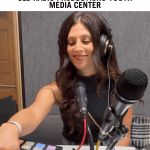
During my visit at SLB Radio Youth Media Center, I had the opportunity to meet Larry Berger, the Executive Director of SLB Radio Productions, explore the studio, and even test out the equipment with lovely talk about books with Larry and my own teenaged daughter (see the Reel here).
In this blog post, I’m going to share what I learned during this experience and what you can take from it for your own classrooms!
What the Research Tells Us
In my favorite book on learning, How the Brain Learns, Sousa makes it clear, when students are engaged and interested in their learning, they’re more motivated and they are more likely to retain content. As recent trends have shown us, podcasting can be a great catalyst to engagement through creativity, self-expression, and exploration.
While podcasting is not a new medium, it is a trending medium. According to the most recent data by the Pew Research Center, podcast monthly listening for Americans 12 years of age and older has risen from 9% in 2008 to 42% in 2023 (the last reported data). Similarly, podcasting has increasingly become more prevalent in schools. In one survey of over 500 teachers, 60% reported using podcasts in their classrooms!
What SLB Is Doing Differently
Considering this data, it’s no surprise SLB Radio Youth Media Center has been a success for teens, but success didn’t happen by accident. SLB has collected their own research to make the space such a valuable learning opportunity for young people. The SLB team visited other media centers across the US to create a place where students can get behind the microphone themselves. They’ve created a space where young people can use digital media for good: to express their own creativity, learn about audio production, and enhance their communication skills.
SLB is committed to providing a space where teenagers can express themselves through digital media. As Larry explains, “Kids only have one chance to be 15 or 16. You want to dip your toe into audio drama? Come, let’s do it. You want to record some poetry? Let’s do it. There’s something different every day.”
Their experience tells us that structured flexibility is the key to engagement. Through their own exploration, they found that the “Open Studio” concept was too broad, and they saw a great increase in participation when they created specific activities for teens while also offering open-ended sessions. Additionally, they adopted a Youth Advisory Council to create bylaws for and a code of conduct offering a collaborative opportunity to shape the nature of the learning space.
What Educators Can Take From It
For educators wanting to create podcasting opportunities for their students, SLB has discovered some great takeaways along the way. First, if you’re interested in creating an after-school podcasting community, you should take their advice and consider accessibility. For example, it’s vital that you consider transportation needs, economic constraints, and time constraints they may have with competing extracurriculars.
Additionally, another key takeaway was that broad invitations to record podcasts don’t always land with teenagers. They recommend clear, specific activities with defined outcomes. Therefore, they suggest using podcasting as a creative tool makes other forms of learning irresistible. Therefore, if you don’t have the means to set up a studio separate from your class, you might consider making it part of class. You, for example, could incorporate podcasting as the assessment at the end of a unit with specific guidelines and objectives, rather than only offering it as a choice. There are simple recording programs that could make this possible for the sake of an in-class assignment.
Conclusion
I’m so thankful to have had the opportunity to visit SLB Radio Youth Media Center, and I’m already brainstorming ways to incorporate what I learned into my pre-service teacher courses (or better yet, take a field trip to visit!!).
There’s no surprise to me that SLB Radio Youth Media Center is highlighted in The 57! There is so much inspiration that I can take as an educator, apply to my classes, and of course, celebrate the innovations of the past 20 years! You can check out the collection here.
I hope you’ll take inspiration from my experience at SLB radio and the other stories shared in the The 57 to make the next 20 years of learning just as bright!
Thank you to Remake Learning for sponsoring this post!



Leave a Reply